ux strategy & product concept
LEGO RE-CREATE
LEGO Re-create: The Infinite Play Loop
Transforming the "Final Click" into a gateway for narrative play and real-world rewards.
THE CHALLENGE
The LEGO experience has historically been defined by the "climax of completion"—that moment of satisfaction when the final brick is put into place. However, through user journey mapping, I identified a significant "Post-Build Abyss." Once the building process ends, the emotional engagement drops as the set transitions from an interactive toy to a static display piece. For many users, especially the younger demographic, this marks the end of their active relationship with that specific product.
From a UX perspective, this represents a massive missed opportunity for brand ecosystem retention. The physical manual, serves as a linear guide that "dies" the moment the project is finished by failing to provide a clear "What’s Next?". This gap in the lifecycle is where the connection between the consumer and the digital LEGO world is most fragile.
My mission was to redefine the "System-in-Play" for the digital age. I tried to design a solution that doesn't just treat the digital app as a utility for PDFs, but as a narrative engine that pulls the user back to the physical. The goal was to transform a linear product journey into a circular ecosystem where completion is merely the "Level 1" of a much larger, ongoing adventure.
The heart of this project is the LEGO Re-Create Hub, a phygital experience that introduces a living layer to the building process. The journey begins with an QR code on the final page of the physical manual. Upon scanning, the user unlocks a "Digital Vault," where the set is registered and a Virtual Buddy is born. This buddy is a theme-specific companion—like a dragon for a medieval set or an astronaut for a rocket —designed to act as the emotional bridge between the online and the physical.
The Virtual Buddy utilizes an "App-as-a-Companion" model rather than an "App-as-a-Distraction" model. Instead of keeping the user’s eyes glued to the screen, the Buddy acts as a narrative guide that comments on the physical build through Augmented Reality (AR) or interactive dialogue. This creates a sense of "Living Play,". This character-driven UX fosters a deeper emotional attachment to the physical product, increasing its perceived value and longevity.
By integrating safe, kid-friendly AI, the Buddy can recognize the specific set the user has built and offer contextually relevant interactions. For example, if a child finishes building a police station, the "Police Chief Buddy" might congratulate them on securing the city, immediately establishing a role-playing scenario. This moves the user from the role of a "mechanic" (following steps) to a "storyteller" (creating adventures), which is the core essence of the LEGO brand values.
To solve the problem of sets becoming static, I developed the Active Quest System. This feature uses the digital platform to issue challenges that can only be solved in the physical world. Periodically, the Virtual Buddy sends the user "Side Quests" that require them to modify or expand their build using their existing brick collection. These quests are designed to trigger "Free-Building"—the most educational and creative form of LEGO play—by providing a narrative "Why" behind the creative act.
Instead of providing a 50-step manual for these quests, the app provides prompts and inspiration. For instance, the Buddy might say, "A storm is coming! Can you build a shelter for the horses using the extra bricks in your bin?" This forces the user to problem-solve, experiment with geometry, and use their imagination without the safety net of a pre-determined guide. It effectively gamifies the physical act of building, turning the bedroom floor back into a creative laboratory every single week.
The loop is closed through Visual Validation. Once the user completes the physical quest, they capture a photo of their creation within the app. Using image recognition, the app validates the effort, and the Virtual Buddy celebrates the achievement. This feedback loop provides the instant gratification that modern users crave, but ties it directly to a tangible, physical accomplishment. It reinforces the idea that LEGO is not a "one-and-done" activity, but a platform for constant evolution.
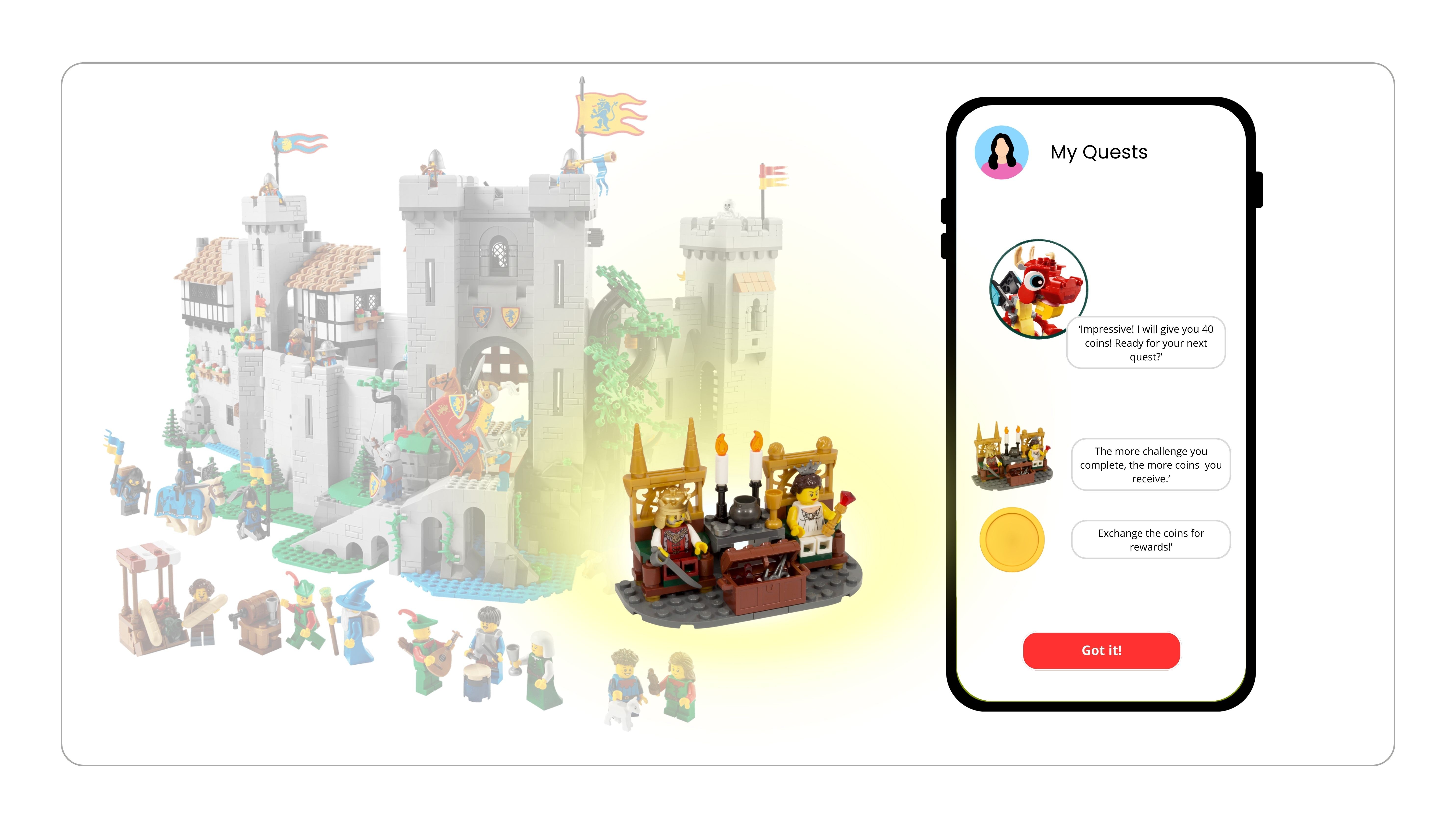
The final, and perhaps most strategic, layer of the project is the integration of a "Play-to-Earn" Economy. Understanding that long-term engagement requires both emotional and tangible incentives, I designed a system where completed quests reward the user with BrickCoins. They are a bridge to the real-world LEGO economy. By syncing the Rebuild Hub with the existing LEGO Insiders program, the digital efforts of the user are translated into actual financial value.
This creates a powerful "Purchase ➔ Play ➔ Reward ➔ Re-purchase" cycle. As users earn BrickCoins through their creativity, they accumulate discounts that can be redeemed at LEGO Stores or online. This directly addresses the business goal of increasing Customer Lifetime Value (CLV). It turns the act of playing with old sets into a "savings account" for the next set, ensuring that the brand remains the top choice for the user’s next birthday or holiday purchase.
From a data perspective, this system is a goldmine for product development. It allows LEGO to see which "Side Quests" are most popular and which sets are being "remixed" the most. This provides a level of post-purchase insight that was previously impossible to track. By rewarding the user for playing, LEGO gains a loyal, engaged community that is constantly interacting with the brand, making the Relive Hub a win-win for both the imagination of the child and the growth of the company.
Step 1: The Portal (Digital Entry)
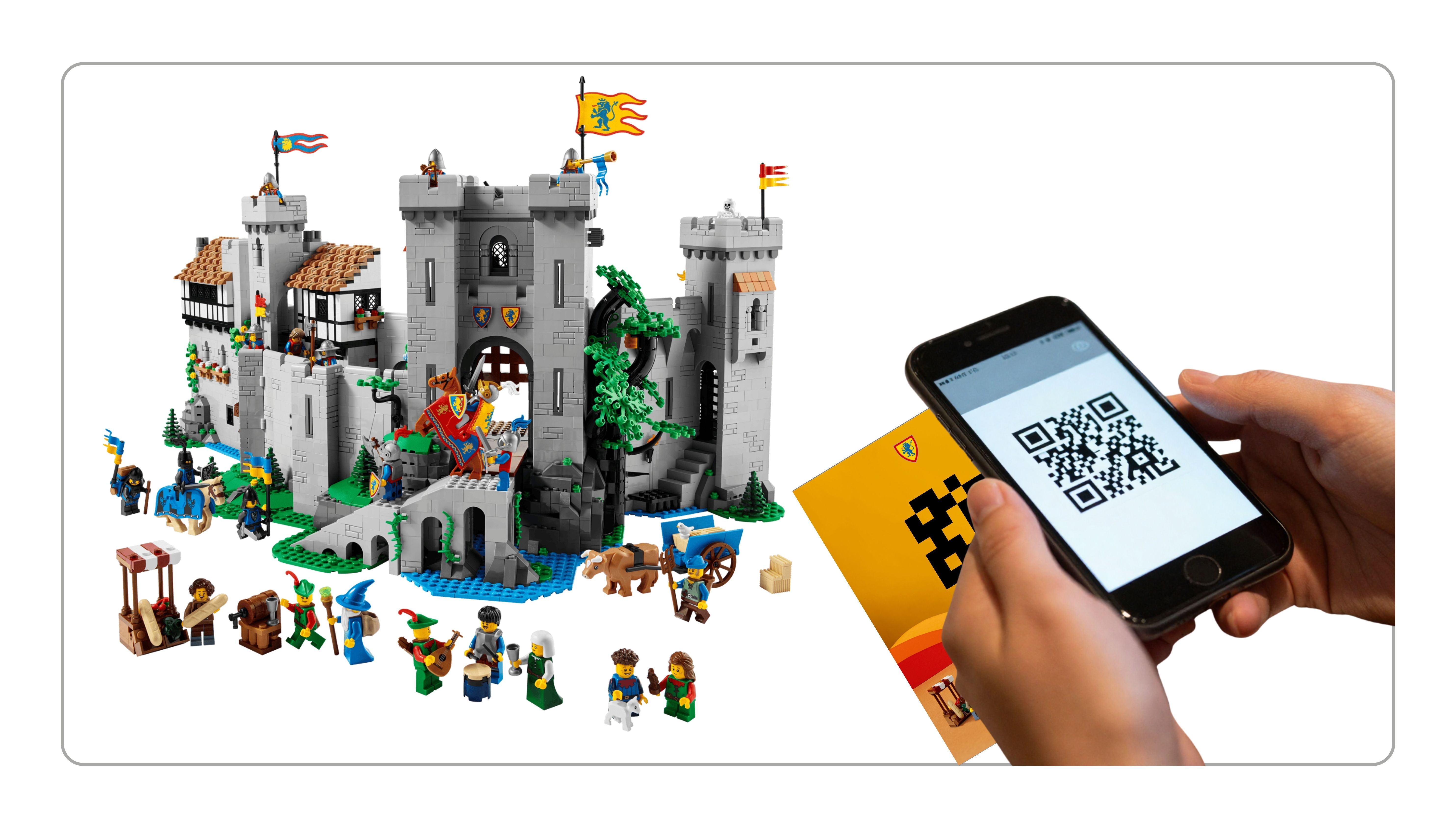
Action: As soon as the user finishes building the physical set, they find a QR Code on the last page of the instruction manual.
What happens: By scanning, the Hub identifies the set (e.g., Castle of the Lion Knights) and adds it to the user's "Digital Collection".
UX Insight: This transforms the paper manual into a digital key, ensuring that the user enters the LEGO ecosystem at the moment of greatest satisfaction (completion).
Visual: A hand holding a smartphone and scanning the QR code on the last page of a physical LEGO manual.
Caption: Scan to Unlock. The paper manual ends, but the digital story begins. Your physical set is now "alive" in the LEGO ecosystem.
Step 2: The Awakening of the Buddy (Narrative Connection)
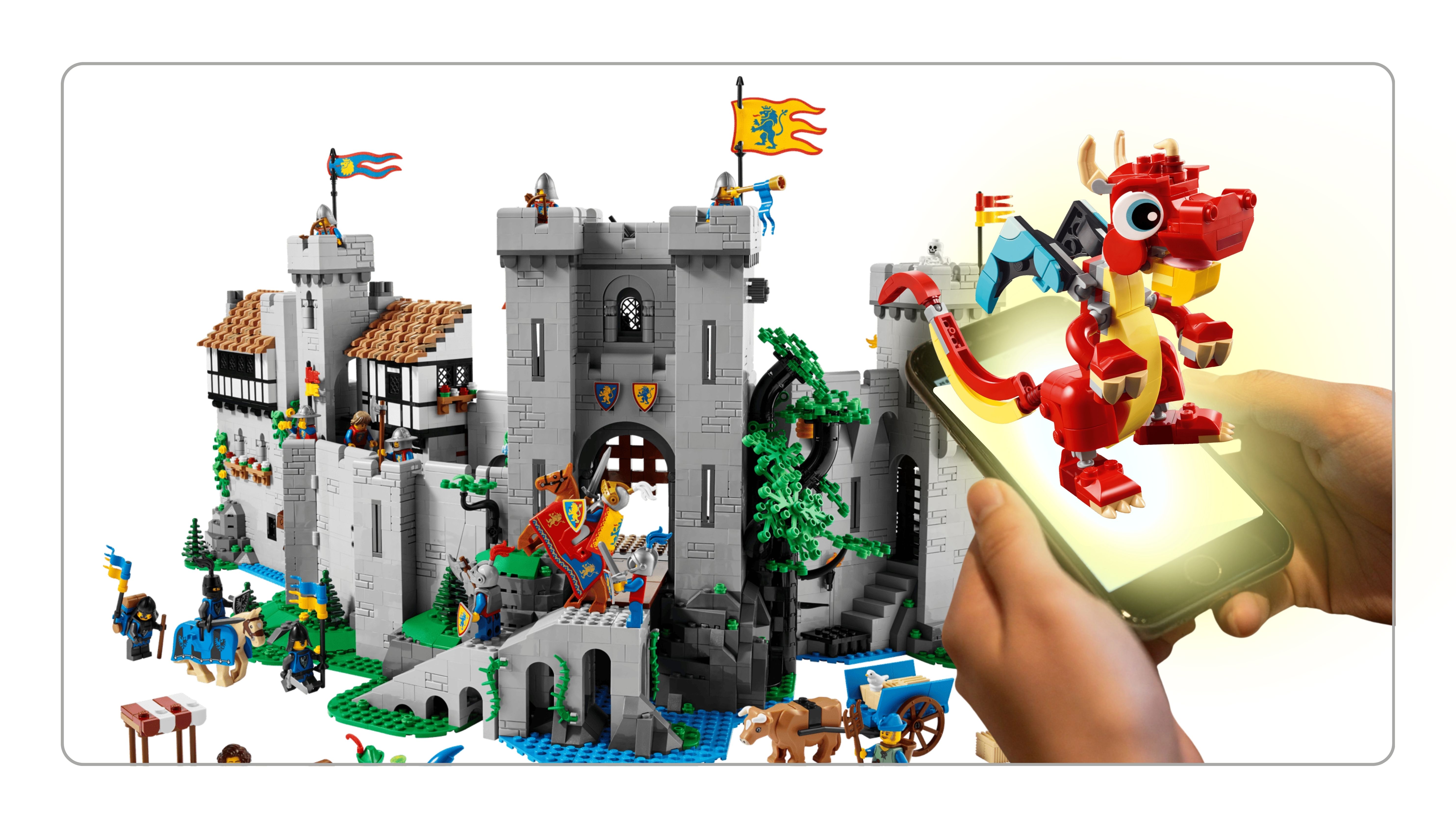
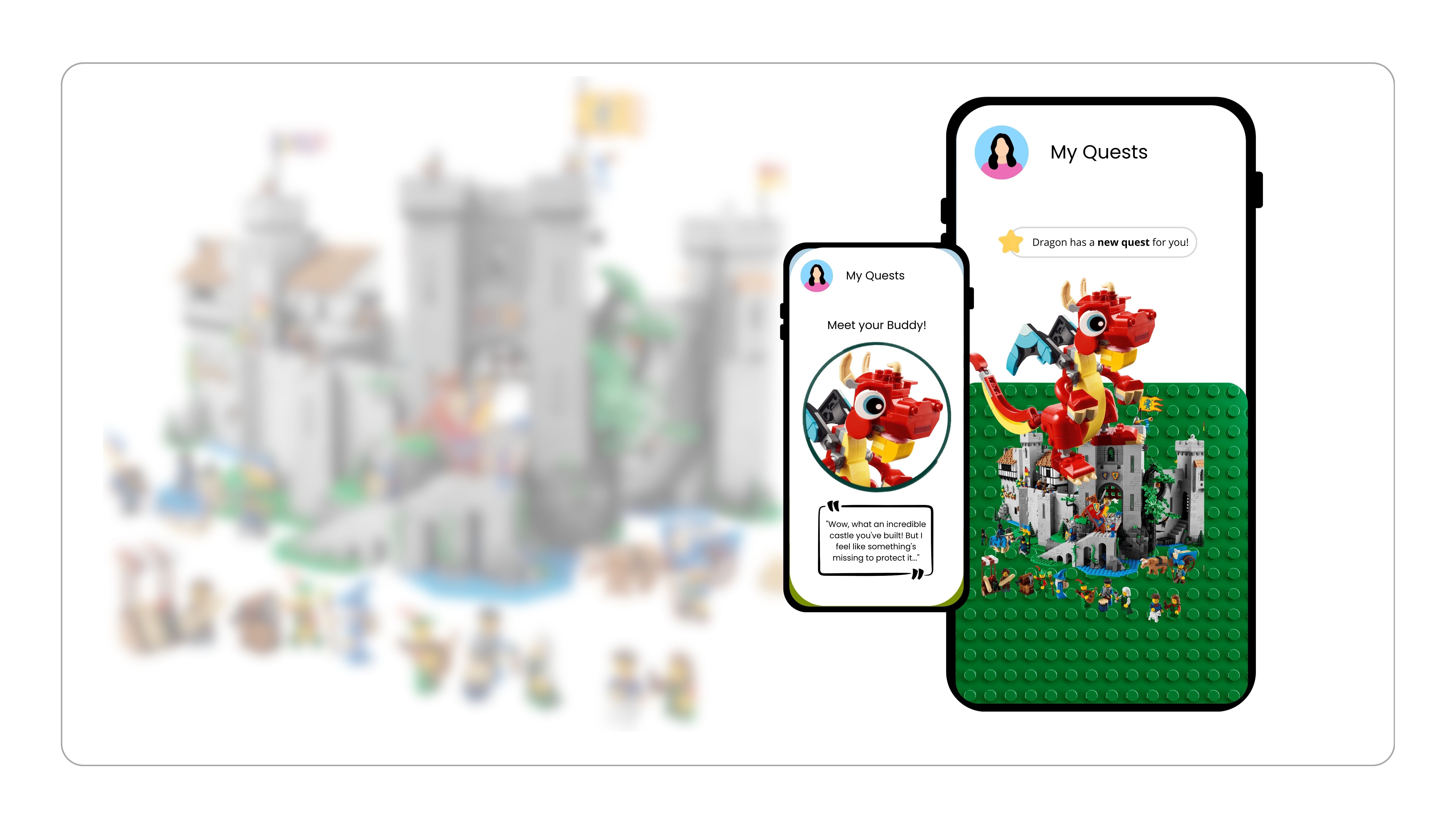
Action: The Virtual Buddy (the specific virtual friend for that theme) appears on the screen with a welcome animation.
What happens: The character interacts with the set in front of the user.
UX Insight: We create an immediate emotional bond. The set ceases to be merely plastic and begins to have an "inhabitant".
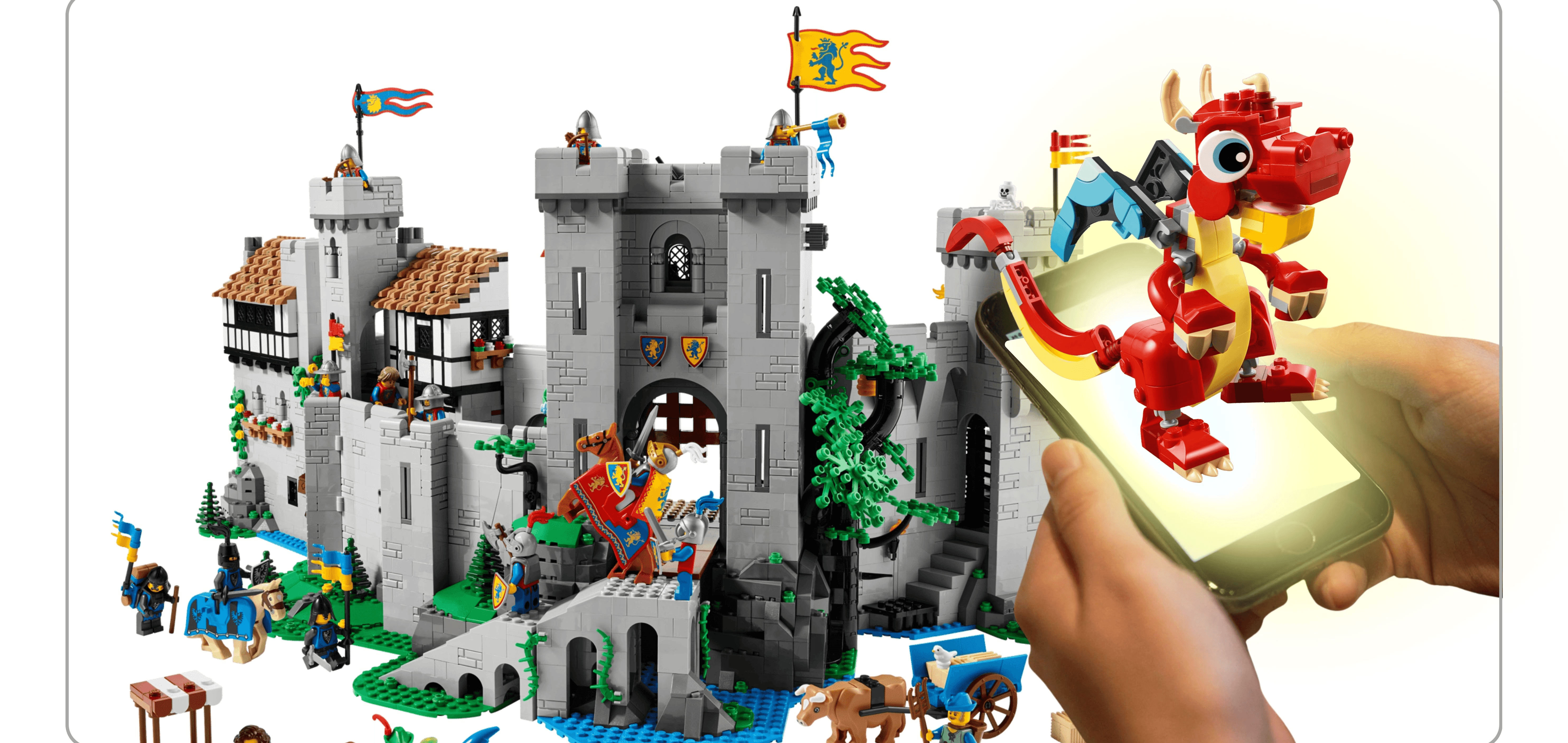
Visual: The cell phone screen shows the Virtual Buddy (e.g. the Dragon) superimposing the real set through the camera (AR).
Caption: Meet your Buddy. A character tied to your specific set wakes up. It recognizes your build and establishes an emotional bond through interactive dialogue.
Step 3: The Active Mission (The Quest)
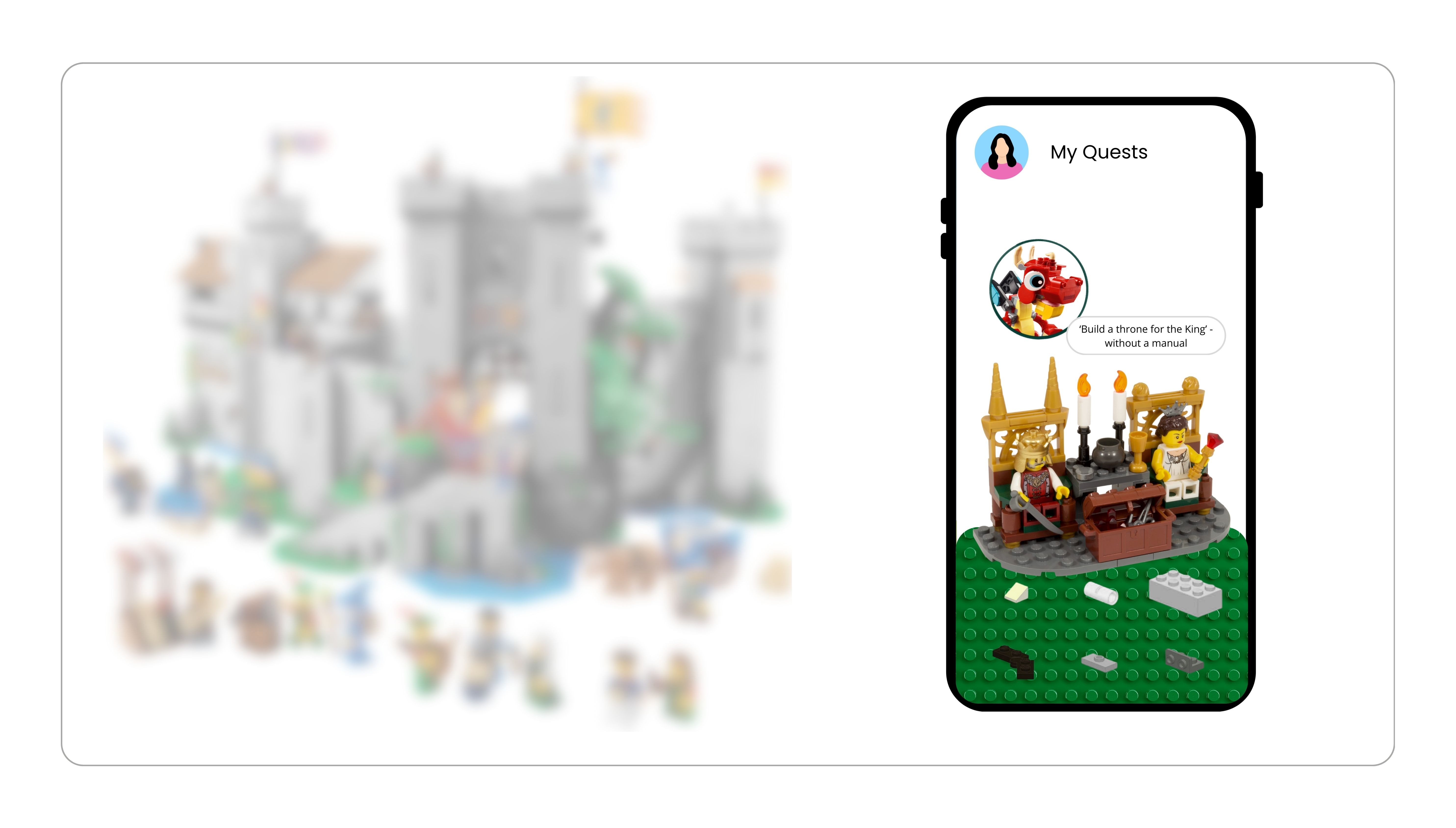
Action: The Buddy proposes a "Side Quest" that requires action in the real world.
What happens: The app suggests a free-building challenge: "The King needs a secret carriage! Can you build one using only leftover spare parts or parts from other sets?"
UX Insight: Here we break the "build and store" cycle. We force the user to return to the mat and use their creativity outside the manual (the Free Building concept).
Visual: The app shows a mission card: "Quest: Build a throne for the King". In the background, we see LEGO pieces scattered across the screen.
Caption: The Buddy challenges you to build something new without a manual. It pulls the user back to the physical bricks, engaging free-form creativity.
Step 4: Recognition and Reward (Validation)
Action: The user builds the physical carriage and takes a picture through the app.
What happens: The AI system recognizes the construction and the Virtual Buddy celebrates. The carriage now appears in the character's digital inventory. The user earns a "badge" or unlocks the next chapter of the digital story.
UX Insight: Hereby closing the loop. Physical effort is validated by digital technology, generating the desire to continue playing.
The Incentive Loop:
From Bricks to Benefits To drive long-term retention, I introduced a reward system where every completed quest grants the user digital coins. These coins aren't just for the app—they are integrated into the LEGO Insiders program. Users can exchange their earned digital currency for real-world discounts in LEGO stores. This creates a powerful 'Play-to-Earn' cycle that incentivizes creativity while driving repeat purchases and store visits.
Sustainability (Circular Play): By encouraging "Re-builds," the project aligns with LEGO’s mission to promote the longevity of bricks and reduce waste.
Retention & Data: Provides LEGO with insights into post-purchase behavior—knowing which sets are rebuilt most often and what themes spark the most creativity.
Smart Cross-Selling: "You have the Castle; your Dragon Buddy needs a Dragon Pit! Check out these compatible sets."
This case study represents my belief that great design doesn't end when the product is delivered. It’s about designing the emotional lifecycle of an object. As a UX/UI Junior, my goal is to prove that I have the technical skills to prototype and the strategic mind to innovate within a world-class brand.
"Only the best is good enough. And the best is always a work in progress."